Ş. Dilsoz – Ş. Agir – Ş. Gîvara – Ş. Rodî Çekdar – Ş. Rodî Deysie – Ş. Soro – Ş. Demhat – Ş. Zafer
We remember our Şehîds of July
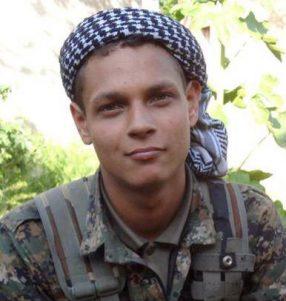
![]() Dilsoz Bihar – Kevin Jochim
Dilsoz Bihar – Kevin Jochim
 Dilsoz Bihar – Kevin Jochim
Date and Place of Birth: 2 November 1993 – Karlsruhe, Germany
Date and Place of Martyrdom: 6 July 2015 – Shergirat, Suluk, Tal Abyad
“Everyone can become part of the revolution in Rojava. Of course, if you are a person who stands up for democracy, equality, justice and freedom. These values are the basis of the revolution in Rojava, values of humanity that have been lost in 5,000 years of history. If we look at the system of capitalist modernity, the essence of being human has been lost. The revolution in Rojava is a renaissance of human values. It is a renaissance of the values of democracy, justice, freedom, equality. We are recreating these values and giving them back to humanity. This is exemplary for the whole world.”
Ş. Dilsoz Bihar
Heval Dilsoz, born as Kevin Jochim in Karlsruhe, Germany in 1993, first came to Kurdistan in 2012 after coming into contact with the Kurdish Freedom Movement in Germany. At home in Germany, he was mobilised within the Marxist-Leninist movement and his political actions were guided and underpinned by this ideological position. When he came into contact with the ideas and writings of Abdullah Öcalan, he began to shift his position. He came to believe that Marxist-Leninism could not address the problems that humanity was facing and saw Democratic Confederalism as a real way forward for the people. In November 2012, Heval Dilsoz took a new path, high in the Qandil Mountains which straddle the border between Iran, Iraq and Turkey. With the guerrilla in the mountains, he undertook an education that revealed many new ideas to him – military, political and in daily life. A comrade who was there with him during this training remembers “Heval Dilsoz became a role model in life, work and education. Most striking was his rapid progress in the Kurdish language, both in Kurmancî and in Soranî. He was able to achieve this through eagerness to learn and the willingness to understand everything and to be involved in all aspects of life. He never remained passive… He criticized false approaches without fear or ulterior motives and although still new, he always tried to to share what he understands with all his friends. Arrogance or looking down on others were foreign to him. Openly and with great interest he met all people and thus collected in a short time much knowledge of the country and culture.”
As a result of his rapid development, politically, militarily and culturally, and his open personality, he quickly found himself taking on positions of responsibility. After leaving the mountains, he came to Rojava, where he served as commander of a unit of internationalist volunteers fighting in Cizîrê Canton. Heval Dilsoz spent many months fighting at the forefront of Operation Martyr Rubar Qamişlo.
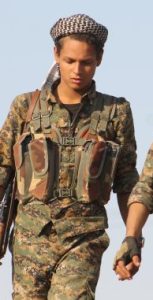
Speaking about his motivation to join the fight he said “I want to learn from this revolution. Because this revolution, this system in Rojava, could become an alternative for all of the peoples in the world. It could become an alternative to all of the ideologies which have not provided solutions. It could become an alternative for the world and for Capitalist Modernity today.”
It is clear that amongst the Kurdish Freedom Movement and in Rojava, Şehîd Dilsoz found the kind of collective experience of life that he was looking for. “Our friendship here means we help each other 24 hours a day,” he reflects in a video. “We are also ready to lose our lives for our friends. And while living we support each other and become stronger together. Our basis is friendship. Our soul is based on friendship. This is what living with the YPG has taught me.”
Şehîd Dilsoz was martyed alongside 5 other fighters on 6 July 2015 when Daesh terror gangs launched a suprise attack in the village of Shergirat near the town of Suluk, Tal Abyad.
Agir Şervan – Levi Johnathan Shirley ![]()
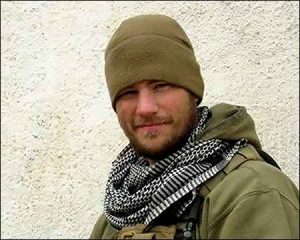
Date and Place of Birth: 23 August 1991 – Nevada, USA
Date and Place of Martyrdom: 14 July 2016 – Minbic
“I thought to myself, there’s got to be something I can do to stop that.”
Ş. Agir Şervan
Born in Nevada, and raised in Colorado, USA, Şehîd Agir first came to Rojava in February 2015. At that time, he fought on the front lines in the Şehîd Rubar Qamişlo operation. After just a few weeks in the country, he found himself in the midst of heavy fighting on the Til Temer front, with one comrade remembering “His unit had come under a brutal and sustained night attack by ISIS fighters. Agir and his comrades had the higher ground so after a long night 12 Isis lay dead and only one Kurdish fighter was slightly wounded. It was a brutal introduction to the International Volunteers in Syria but it was exactly what Agir wanted. He came to fight and participate in the destruction of one of the most vicious ideologies of hate this world has ever seen.”
“He’s not usually what you would first think of as a fighter,” his mother Susan Shirley said. “He’s not someone who would strike out an offensive on someone. But he also has a strong sense of justice and sticking up for the underdog, and the Kurds are about as underdog as you can get right now.”
After participating in the liberation of Mount Kezwane, Heval Agir returned to the USA. Not content to leave the responsibility of defeating Daesh to others, in January of 2016 he returned to Rojava. He took up the fight once again in Cizre and Kobanê cantons before joining the defence of the Martyr Abu Layla refugee camp during the liberation of Minbic. “Long before he got involved, there were other families all over the Middle East and Europe who were going through this, you know, losing their sons and daughters and people that they loved,” said Levi’s sister Kate. “And my brother didn’t want anybody else to have to go through that.”
“I saw a video of them lining up kids and doing stuff I’d never seen terrorist organizations do on that kind of scale,” Shirley said in a video made by a documentary filmmaker in early 2016. “It made me angry and it shocked me and it made me feel every possible emotion that you could possibly think of when you think of a disgusting act being committed like that. And so then I thought to myself, There’s got to be something I can do to stop that.” Heval Agir was a true internationalist who was deeply proud of his American roots. He had a deep desire to fight for humanity, to help the people of the Middle East to liberate themselves from the clutches of ISIS, calling them the “single greatest threat of man-kind since Nazi Germany.” “They’re my definition of pure evil,” Levi said in a video. “I don’t think good people in a society can stick other people inside of a cage and set them on fire, so — yeah, I came here to stop that.”
“He joined the heroes that history needs, the long line of people who push up the human condition to something better. That’s what I remember when I think of my friend. I think about his family, and all the things he would have done if he was still there. He’s a hero, and I hope that people in their daily life, when they walk on the street, have fun or just relax in their room, remember that the price of peace is the blood of people who said no.” – Heval Gabbar Tolhildan on Şehîd Agir.
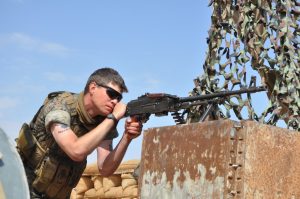 He was at the forefront of some of the heaviest fighting in the War Against Daesh, in Shadadeh, Ain-Issa, and then in Minbic. On 14 July 2016 Şehîd Agir was martyred during the operation to liberate Minbic. He and another comrade began searching a building which had been cleared from Daesh fighters. After stepping through the door, he triggered an IED which killed him instantly and seriously wounded the other heval. In a statement the YPG said he was “known for his discipline and sense of responsibility.” “His style and personality were a source of strength, motivation, and morale for his friends. In the fight, Heval Agir was known and respected as a brave and altruistic person. We can say that Martyr Agir strenghtened our brotherhood and fought for the freedom of an oppressed people. The sacrifice of our comrade Agir has enriched the democratic revolution being fought in Rojava. His name has been written in the history of our brotherhood.”
His body was repatriated to his home in Colorado, alongside fellow Coloradan fighter Ciwan Firat (Jordan McTaggart), who also fell Şehîd in the Minbic campaign. Friends and family celebrated his life and memory in an emotional service in the Church of Christ the King, Denver.
![]() Gîvara Rojava – Dean Carl Evans
Gîvara Rojava – Dean Carl Evans
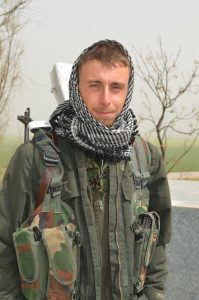 Gîvara Rojava – Dean Carl Evans
Date and Place of Birth: 7 October 1993 – Reading, UK
Date and Place of Martyrdom: 21 July 2016 – Minbic
Heval Gîvara had a revolutionary, warrior spirit, he fought without hesitation and sacrificed his life to protect the people of this region. Since he was a boy he had the ambition to be a soldier. As a youth he joined the British Army cadets but was unable to continue his military career due to asthma. At home he worked to support his family as a dairy farmer. Şehîd Gîvara first came to Rojava in March of 2015. Like many across the world, he was outraged by the criminal actions of Daesh, but Heval Gîvara was not prepared to sit by and watch the slaughter unfold. Shortly after his arrival he explained: “It was the fact that I knew people were coming here to help. It didn’t fit right with me that I was at home living my comfortable life when I could be here.” After a short period of training he went straight to the front and into the midst of fierce fighting. In the words of YPG command, he showed “revolutionary and combative spirit on the front lines and always fought without hesitation to protect the people of this region.” After the liberation of Til Temir he returned home to Britain to be with his family. He was not able to stay for long, and soon found himself longing to return to fight alongside his comrades again. In January of 2016 Heval Gîvara Rojava returned once again to the struggle he so deeply believed in. His return to Rojava exemplified who he was and his passion to liberate the world from all forms of oppression.
Şehîd Gîvara’s step-father Dean spoke highly and with great respect of the young man he had raised with his mother Jo, who passed away in 2011. “Our son is a martyr. We are proud of what he did. He was always prepared to stand for what he believed in. He was not a glory hunter, he wanted to feel like he’d done something with his life. He was a humanitarian.”
Heval Dilsoz Tolhildan, who had fought alongside Şehîd Gîvara, in remembrance said; “Heval Gîvara gave his life for the fight for justice and freedom in the fight against the most inhumane gang on this planet. To give justice to such a human and his struggle is not easy. Heval Gîvara was no politician, he was no former soldier, but for me he was one of the most impressive fighters I ever met. Heval Gîvara was a normal human, an English boy from the countryside with the aim to fight Daesh. He was a young man who saw the need to stop evil who turned into a soldier, a comrade and friend who did not care if someone was Kurd, Arab, Muslim or Christian. In the battle against the enemy Heval Gîvara fought at the very frontline constantly searching for the right, not the easiest way. With his determination and way of fighting he took on the enemy without hesitation. This made him a blueprint and source of inspiration who gave us energy and motivation especially in difficult situations. I will never forget the time we spent together. His memory as a human and fighter will always be a shining beacon of hope in dark and lonely moments. All of us should try to live up to his memory and continue the fight for humanity and freedom. We should do this to honor our fallen such as my friend Gîvara.”
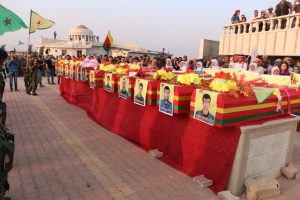 Heval Gîvara was martyred on 21 July 2016 at the forefront of the fight for the liberation of Minbic. Wounded by a sniper’s bullet, he managed to apply first aid to himself. He was martyred alongside a YPJ comrade who rushed to drag him to safety when they were hit by a rocket. In accordance with his wishes to be buried alongside his brothers and sisters in arms, Şehîd Gîvara Rojava was buried in the martyr’s cemetery in Derik.
Rodî Çekdar – Martin Gruden ![]()
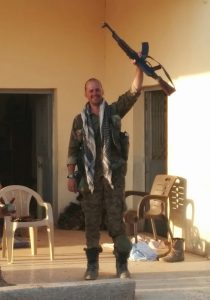
Date and Place of Birth: 27 October 1983 – Ljubljana, Slovenia
Date and Place of Martyrdom: 27 July 2016 – Minbic
Martin Gruden was born in Ljubljana in Slovenia (then Yugoslavia) in 1983. Just three years previously, the leader of Yugoslavia, Josef Tito Broz had died, marking a time of political, social and economic upheaval, but in spite of this Martin enjoyed a carefree and pleasant childhood in the green and pleasant suburb of Ljubljana where he grew up. Martin grew up with his two sisters, the youngest of three siblings. As a young boy, Martin loved to spend his summers with his grandparents in a small seaside town by the Adriatic coast. Both of his grandparents had fought as anti-fascist partisans during the Second World War, his grandmother even being awarded a medal for bravery. His sister remembers: “The military stories contained in the small library in his grandparents’ house were endless. Perhaps it was these stories, that helped Martin develop a great sense of justice at a very early age – he simply did not tolerate injustice. He got into trouble several times at school precisely because of his truthfulness.”
“Even as a child, Martin was gentle, quiet and calm, and he remained such throughout his life,” continues his sister. “He remained loyal to the values he acquired as a child. He was polite and always ready to help, thrifty, yet generous when needed. Characteristically persistent and determined, almost stubborn.” As he grew older, he developed a keen interest in outdoor sports and physical fitness, an avid surfer and mountain biker.
In the turbulent economic circumstances of the newly-independent Slovenia following the breakup of Yugoslavia in 1990, finding stable employment was not easy. “It was extremely difficult for young people to get a job,” recalls his sister. “Martin never gave up, he always found a job or the job found him.” Martin trained as a mechatronics technician in the field of telecommunications. He was fascinated by computers and technology and loved to take things apart and put them back together again, to understand how they worked. He lived with his family for most of his life, only moving into an apartment of his own a year before he left for Syria.
When Martin left to join the fight against the Islamic State, he kept the true purpose of his journey tightly guarded even from those closest to him. “Perhaps when he left, his concern for his loved ones and, at the same time, empathy, determination and the desire to correct injustices were fighting in him – the ultimate goal of his departure remained unknown almost until the end,” said his sister. He left Slovenia on 8 March 2016, and messaged his family from Iraqi Kurdistan. “‘It’s nice here, they take good care of me,’ he wrote in one of the messages. All of them were positive, full of optimism and this meant hope for us as well, despite the indescribable fear we had for him. The hope that he finds his way, his goal.”
After crossing into Syria from Iraqi Kurdistan, Martin took on the Kurdish nom-de-guerre ‘Rodî Çekdar’. At the internationalist academy of the YPG, he received military, ideological and language education. It was not long before Heval Rodî would find himself in the thick of the fighting in the newly-launched campaign to liberate Minbic. Here he fought alongside other internationalist comrades, some of whom would also fall şehîd – Ş. Delîl, Ş. Ciwan and Ş. Firaz among others. Şehîd Rodî Çekdar was a brave and dedicated individual who willingly put his life on the line to smash the occupation of Minbic by the criminal Islamic State. He gave his life in the heart of Minbic to secure the city for those who had been forced to flee from their homes, those still under the reign of ISIS. Fighting until the end for the freedom and safety of others, he was martyred on 27 July 2016 at the forefront of the fight for Minbic city centre.
Reflecting on his choice to travel to halfway across the world to fight for the defense of the Syrian people and their revolution, his sister said: “Martin came from a family where political topics were never taboo and political positions were clearly (and often loudly) expressed. Despite the occasional disagreement, we have always defended political, social and personal freedoms and cultural diversity. Martin has never defined himself politically and has never publicly announced his political convictions, views or preferences for certain political groups. He was guided by his heart. It stopped on 27 July 2016, far from us, from home, from the sea that he adored. But somehow, although with an aching heart, it felt so right to let him rest where he found his second homeland and where he wanted to stay – as Rodî Çekdar.” In accordance with his wishes, Şehîd Rodî was laid to rest in the red soil of Rojava. His strength, courage, passion and compassion remain a powerful example for internationalists.
![]() Rodî Deysie – Nicholas Alan Warden
Rodî Deysie – Nicholas Alan Warden
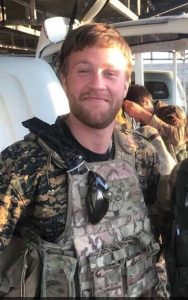 Rodî Deysie – Nicholas Alan Warden
Date and Place of Birth: 17 June 1988 – Fort Stewart, Georgia, USA
Date and Place of Martyrdom: 5 July 2017 – Raqqa
Şehîd Rodî had extensive military experience before he came to Rojava. With nearly 5 years in the US Army, leaving as a sergeant, as well as a stint in the French Foreign Legion, he was already an accomplished soldier before beginning his training in the YPG. He had served two tours in Afghanistan as well as fighting against Boko Haram, an ISIS-affiliate in Africa. A well-liked addition to the YPG ranks, he is remembered by his friends as disciplined, modest, always the first to volunteer for duties, fearless, sociable and with a strong sense of humor.
His father Mark said he started talking about joining the Army after the September 11th attacks on New York City. “Ever since that, he was like: ‘Dad, I’m going in the military, I’m fighting these people,’” his father Mark said. “He’s been battling since he was 18 years old, as soon as he was able to.” “He was very strong-willed and very strong-minded and very much against ISIS and these terrorist groups, and he wanted to do whatever he could to get rid of them. He said not enough people are helping so he had to help.”
“I joined the YPG to fight ISIS because of the terrorist attacks they were doing in Orlando, San Bernardino, Nice and Paris,” Heval Rodî said briefly in a video taken before the battle for Raqqa. “He was just one of those guys that seemed fearless all the time,” Steve Tylka, a friend who served with Warden in the US Army said in remembrance.
On the night of 5 July 2017, in a suburb on the outskirts of Raqqa, Heval Rodî was martyred along with Şehîd Soro Zinar and Şehîd Demhat Goldman when their patrol was ambushed. They came under extremely heavy fire with rockets and mines detonating. By the time other fighters were able to flank the ISIS fighters and rescue the patrol, only one remained alive. Şehîd Rodî and Şehîd Soro died during the firefight while Şehîd Demhat died from his injuries the following day. 3 local fighters from the patrol were also martyred.
Soro Zinar – Luke Rutter ![]()
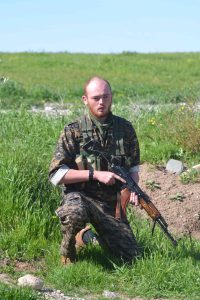
Date and Place of Birth: 22 September 1994 – Birkenhead, UK
Date and Place of Martyrdom: 5 July 2017 – Raqqa
“My reasons for joining the YPG, I think, are like everyone else’s. I think the YPG stands for the best opportunity for peace that this region might have.”- Şehîd Soro in a video taken at the YPG Academy.
Luke Rutter was born in Birkenhead, Merseyside, not far from Liverpool. Soon after arriving in Rojava, 22 year old Luke Rutter went through a period of intensive military, language and political training in the YPG academy. “Despite lacking a professional military background, he was among the best in training,” the YPG revealed in a statement. Although not previously involved in left-wing organising, Heval Soro showed a great interest in revolutionary subjects and participated actively in the academy. In the collective life of YPG, he always helped his comrades and was respected by all. Another English volunteer who arrived shortly after Luke spoke of their experiences together in training, “When I arrived to Rojava I felt uncertain if I would actually be able to contribute, or if I was just kidding myself, but Luke encouraged me, certain I would not be useless.” According to his commanders: “From the very first day until the end of training, Soro gave the impression that he knew what he was doing and what he had come for, and he was always eager to learn new things. We never saw him yelling at anyone or complaining about anything. He participated actively in the collective life, which is promoted within the YPG. At the end of training in the academy, when asked the usual question addressed to every volunteer: ‘Are you ready to fight?’ He firmly responded ‘Yes’ and said he wanted to fight the fascist organisation of IS.” During the training process, Luke developed a close friendship with fellow internationalist fighters Nicholas Alan Warden (Rodî Deysie) and Robert Grodt (Demhat Goldman) and they requested to be sent to a frontline unit together.
Şehîd Soro was martyred on July 5 during the operation to liberate Raqqa, alongside his close friends Heval Rodî and Heval Demhat. A statement from the YPG command said Luke would be “remembered by our people as a hero who sacrificed his life for the sake of protecting the values of the free world. Comrades Demhat, Rodî and Soro, like all their other comrades, joined the fight to end Daesh barbarity and sacrificed themselves for a common and free life for all peoples. Revolutionaries who have strived in their own countries for the freedom of humanity see Rojava as the hope for emancipation for humanity and are joining the revolution, since the Rojava revolution began. Internationalist fighters who joined in the revolution at the very first fronts and who have been martyred have gifted the Rojava revolution to the peoples of the world. 3 of our 6 comrades who fought in the very front lines against ISIS fascism and were martyred were internationalist fighters. Comrades Demhat, Rodî and Soro, like all their other comrades, sacrificed themselves and fought until the end to put a stop to ISIS barbarism and to make sure all the peoples of the world, not just the peoples of Rojava, can have a common and free life.”
Hundreds of mourners gathered to celebrate the lives and sacrifice of the four internationalists who had recently been martyred, including Şehîd Zafer Qereçox (David Taylor) at a martyr’s ceremony in Derik.
Luke’s body was then repatriated to his home in the UK, where he was greeted with a hero’s welcome as he left Manchester Airport. Many English and Kurdish supporters gathered with flags and flowers to pay tribute to his actions. He was laid to rest in a private funeral ceremony for his family and friends in Birkenhead.
Demhat Goldman – Robert Grodt![]()
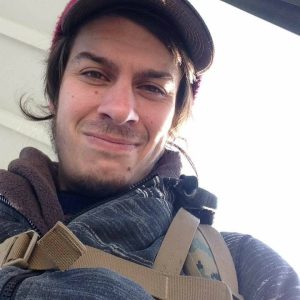
Date and Place of Birth: 23 February 1989 – Santa Cruz, California, USA
Date and Place of Martyrdom: 6 July 2017 – Raqqa
Born and raised in Santa Cruz, California, Robert Grodt lived in New York City in the years before he came to Rojava. He was an active anarchist and was heavily involved in the Occupy Wall Street movement which erupted in 2011 as a protest against the massive wealth inequality and corporate tyranny which dominates the US political and economic landscape.
Robert was a street medic in the movement, treating protestors who were injured in clashes with the police. It was here that he met his future partner Kaylee Dedrick, who he treated when she was pepper sprayed by the police during the protests. The pair soon fell for one another, and their daughter Tegan was conceived in the Zuccoti Park protest camp, leading her to be called a ‘child of the revolution’. “Nothing strengthens a relationship like a chemical agent,” he joked to a journalist.
Already aware of the Kurdish freedom struggle, Robert had watched closely as the resistance of Kobanê captivated the world in 2014. As some of his close friends went to join the historic battle to push back the Islamic State, he felt that he could not leave behind the family he had newly started with his partner. But at the same time “he’s always been Robin Hood,” his older sister Stephanie Eason said. “He will solve any problem. You could count on Robert.” “He went to Syria knowing he was going to receive training and would be placed in situations like that,” Eason said. “He was willing to do whatever it took.” In a video filmed a few weeks before his martyrdom, Heval Demhat said he couldn’t sit idle after, “seeing a real chance to take a hand in something that’s really important for the region.”
Speaking of his desire to see the new system of revolutionary democracy and socialism spread Heval Demhat said “This is a fire that may have started here, but it can kindle elsewhere.” “He was always someone who, when he set his heart to it, there was no changing his mind,” his partner Kaylee said. “It was sad, but I was, and still am proud of him.”
Şehîd Demhat was martyred on July 6, 2017 during the operation to liberate Raqqa, in the same ambush that claimed the lives of Şehîd Soro, Şehîd Rodi and three other fighters.
![]() Zafer Qereçox – David Taylor
Zafer Qereçox – David Taylor
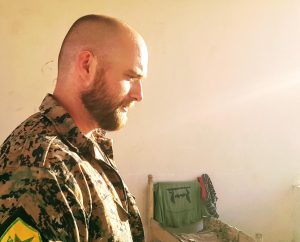 Zafer Qereçox – David Taylor
Date and Place of Birth: 10 February 1991 – Florida, USA
Date and Place of Martyrdom: 16 July 2017 – Raqqa
David Taylor was born in 1991 in Florida, USA. After high school, he studied philosophy at university level, and served for 4 years in the US Marine Corps. This experience had a huge impact on David. “One night he got drunk and told me of the atrocities he had witnessed in the Middle East during his time in the Marine Corps,” a friend of his said in a letter to his parents. “He said to the effect that ‘ISIS was the bane of modern existence and needed to be stopped before they destroy any more lives and priceless works of human achievement.’”
In Rojava he took on the name Zafer (Victorious) Qereçox. Like many others who came during this time, he took on the name “Qereçox” in honour of the Mount Qereçox martyrs, who were killed in a Turkish air strike during the planning of the Raqqa offensive.
“He is so smart and he is so intellectual,” Heval Zafer’s father Taylor said. “He is not going to do something stupid. He was doing what he believed in his heart was the right thing to do and that was for freedom.” Later he stated “[he was] compassionate. He loved his country. He loved everybody and for every reason. He never asked for nothing in return. He was really loyal to his mother.”
Şehîd Zafer was martyred on July 16, 2017 while fighting the terror gang Daesh in Raqqa. After a ceremony in Derik, his body was returned to the USA and laid to rest by his family and friends in the town of Buckannon City, where he was honoured by his former comrades in the US Marine Corps.
In a statement the YPG said “Şehîd Zafer was a wonderful comrade with high ethical and intellectual standards. He was honest and courageous. His integrity was impressive. His humility was inspiring. He had said that ‘The Rojava Revolution is honorable because it wants to grant equal protections and freedoms to women and minorities. This is unique in the region.’ He had gladly taken Qereçox as his second nom de guerre and heroically carried it to the end.”